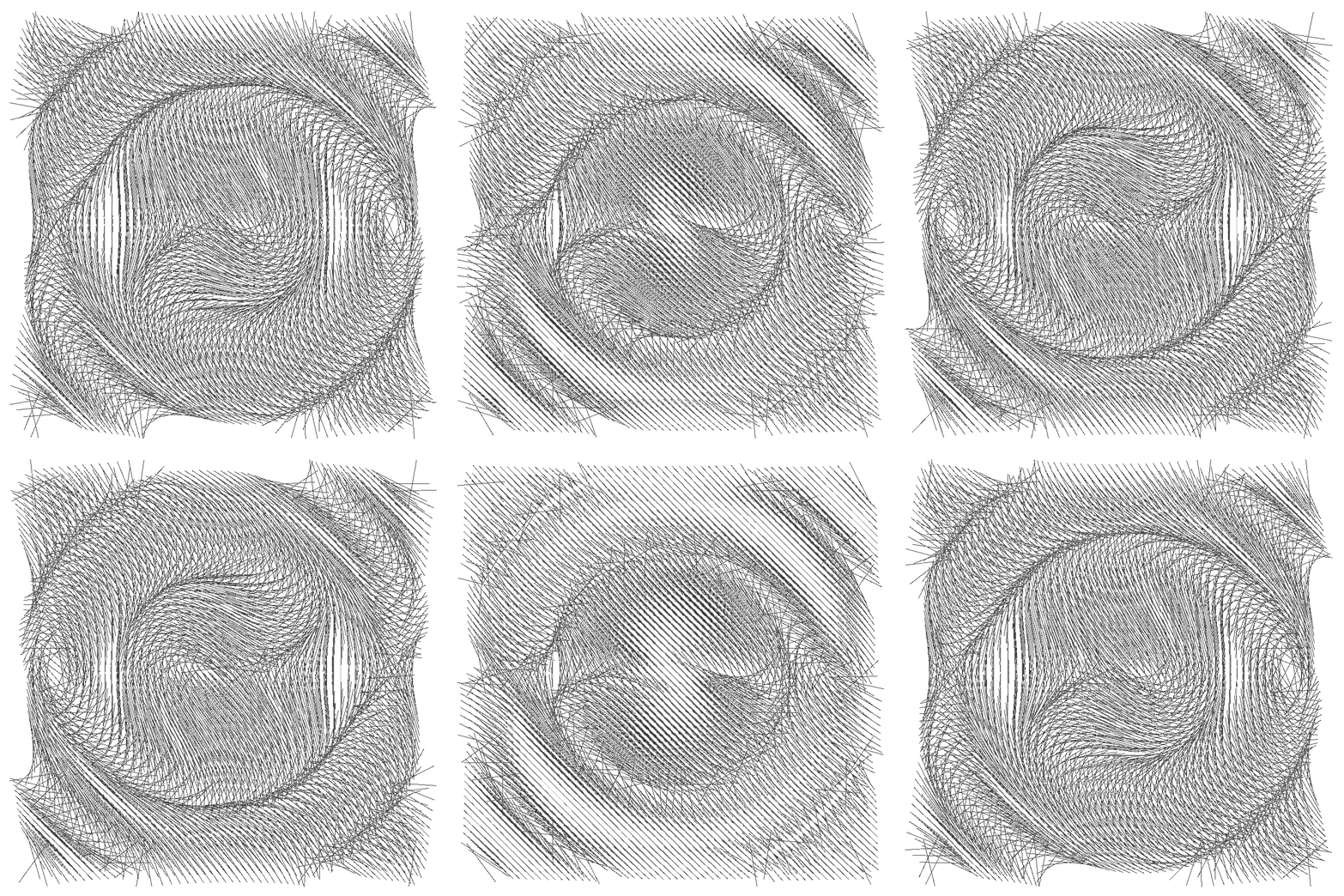
Firstly, we define a vector field each of its points depends on functions of its coordinates. So the two functions are $u,v : \mathbb R^2 \to \mathbb R$, such that $$u(x,y)=x+y, $$ $$ v(x,y)=\tan(x^2+y^2).$$
Our vector field function depends not only on the point but also on another parameter $t$ which we will use to mimic the animation, so $$f(x,y,t)=(u(x,y),t v(x,y))$$ However, we are not finished yet.
We will stick each vector from the function at the point at which it’s evaluated. This will be just a line starting from the point $(x,y)$ and ending at the point $(x,y)+f(x,y,t)$.
But since I care about symmetry in my drawing, I put the negative side of the function to the point. So overall it will be a line starting from $(x,y)-f(x,y,t)$ and ending with $(x,y)+f(x,y,t)$. Explicitly, each line is defined as $$l(x,y,t)=\set{(1-a)\left((x,y)-f(x,y,t)\right)+a\left((x,y)+f(x,y,t)\right)\mid a \in [0,1]}$$
At the end the whole graph is $$G(t)=\bigcup_{(x,y)\in I}l(x,y,t)$$ where $I=\set{0.0075(x,y) \mid -\frac{80}{3}\le x,y \le\frac{80}{3},(x,y)\in \mathbb Z^2}$.
This weird $0.0075$ is just for rescaling the grid.
And the animated graph is done just by varying $t$ between -1 and 1.