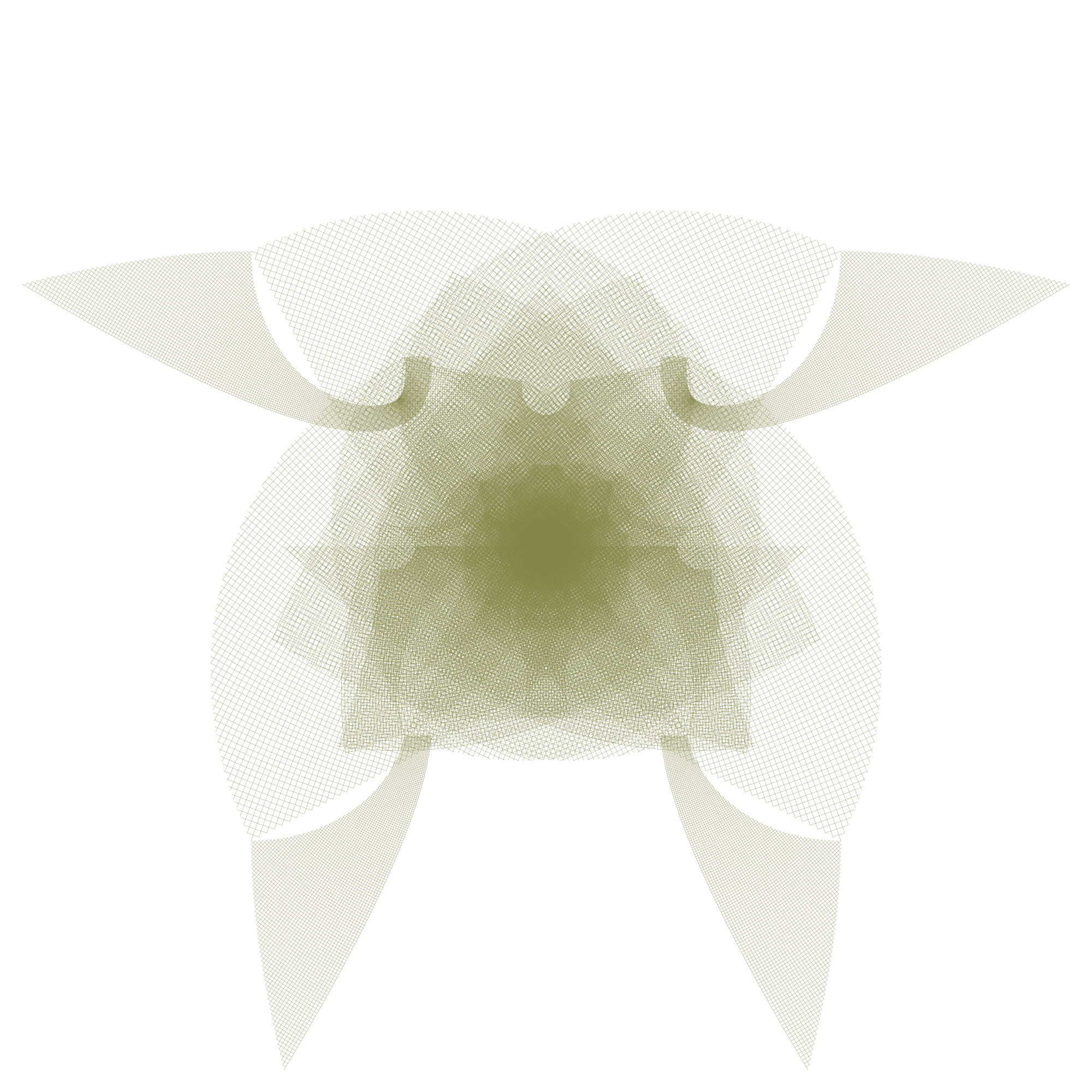
“שְׂרָפִ֨ים עֹמְדִ֤ים ׀ מִמַּ֙עַל֙ ל֔וֹ שֵׁ֧שׁ כְּנָפַ֛יִם שֵׁ֥שׁ כְּנָפַ֖יִם לְאֶחָ֑ד בִּשְׁתַּ֣יִם ׀ יְכַסֶּ֣ה פָנָ֗יו וּבִשְׁתַּ֛יִם יְכַסֶּ֥ה רַגְלָ֖יו וּבִשְׁתַּ֥יִם יְעוֹפֵֽף׃ `”
We define a grid by $$P=\set{0.01(x+iy)\in\mathbb C\mid (x\in\mathbb Z\vee y\in\mathbb Z) ,200\le x,y\le200}.$$
Then we define a complex function,
$$f : P \subseteq \mathbb C \longrightarrow \mathbb C $$
where,
$$f(z)= iz\sqrt i \ \mathrm{mod}(3,z)$$
So, our graph is the image of this function.
In other words,
$$G=f(P).$$
This a video of the graph transformation with linear interpolation.
Defintion of $\mathrm{mod}$ in complex numbers
The $\mathrm{mod}$ is defined like $$\mathrm{mod}(z_1,z_2)=z_1-z_2 \ \mathrm{floor}\left(\frac{z_1}{z_2}\right) $$ And here $\mathrm{floor}$ is the complex floor function attributed to E.E. McDonnell.