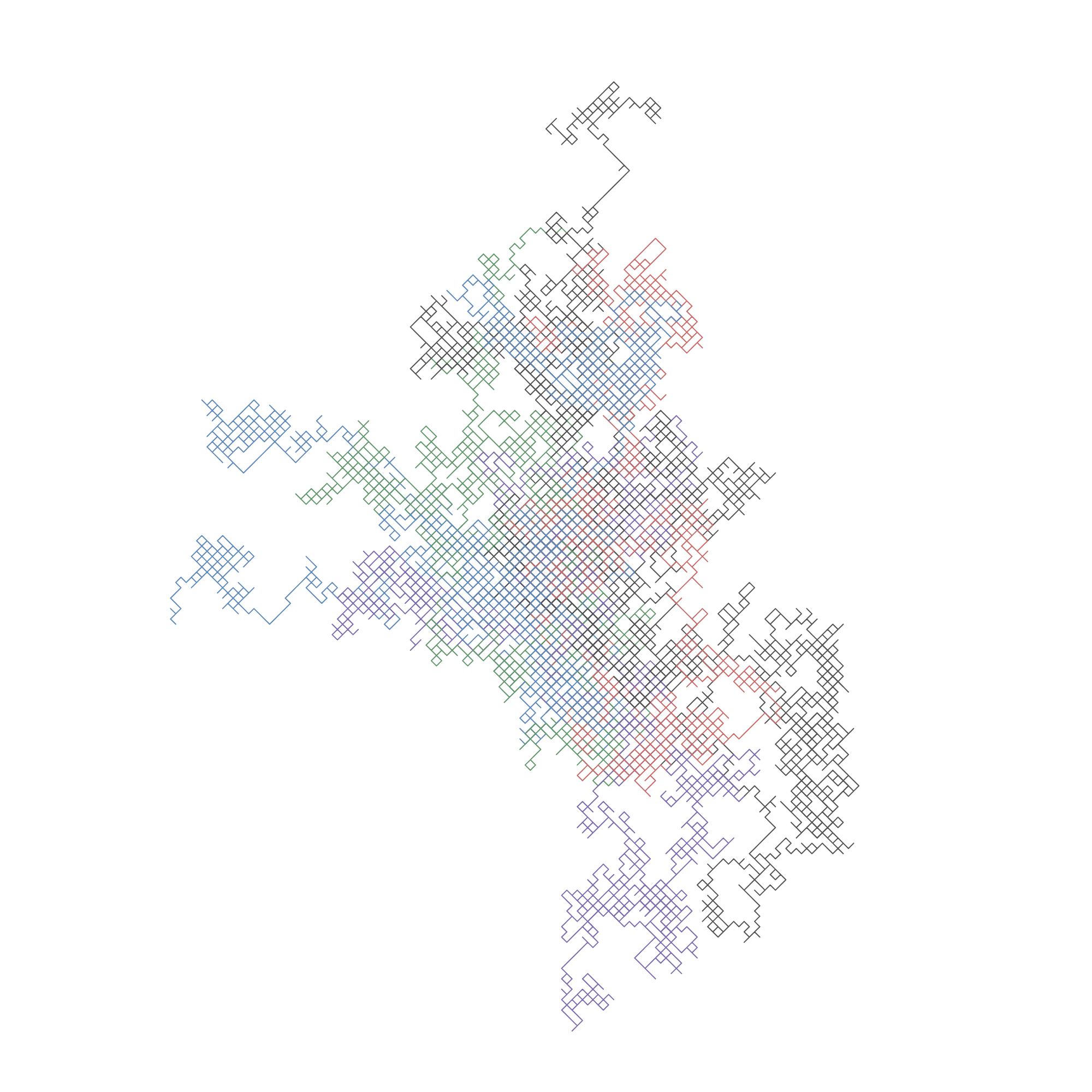
If you want to see the graph evolving for $n$ ranging from $0$ to $1000$ for each of the 21 paths see this video.
For each index $m\in\set{0,\dots,20}$ define a discrete planar random walk $f_m:\set{0,1,\dots,1000}\to\mathbb{Z}^2$ by the recurrence
$$ f_m(0) = (0,0), $$
and for each integer $n\ge 1$
$$ f_m(n) = f_m(n-1) + \big(X_{m,n},Y_{m,n}\big), $$
where $X_{m,n}$ and $Y_{m,n}$ are independent random variables taking values in $\set{-1, +1}$ (each with probability $\frac12$). In other words: at each step the walker moves one unit horizontally and one unit vertically, each independently chosen to be +1 or −1.
So, the next step is a diagonal step. From $f(k)$, there are four equally likely choices, each with probability $\frac{1}{4}$: $$f(k+1) \in \set{ f(k) + (\pm 1, \pm 1) }$$ which looks like the following graph.
$$f(k) \to f(k+1) \to f(k+2) \to f(k+3) \to f(k+4)$$ where $f(k+4) = f(k)$, yet $f(k) \neq f(k+2)$ and $f(k+1) \neq f(k+3)$, tracing a tilted square, as shown in the figure below.
Here is the graph evolving.